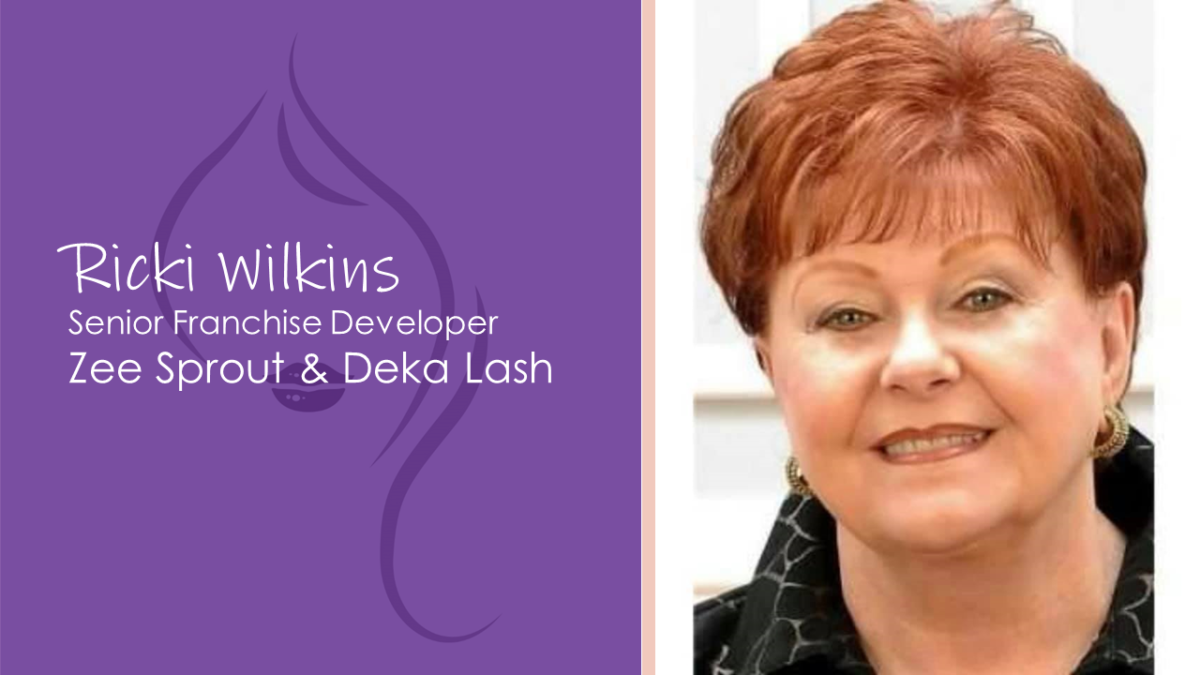
Ricki Wilkins on Where Passion and Purpose Collide

On Where Passion and Purpose Collide, Ricki Wilkins explains how she stood up as a kid at a city council meeting to fight for a dog shelter. That leadership has carried her through life and through her career. She celebrates the success of everyone in her Deka Lash family and creates a culture anyone would want to join! Check out The Coterie for Women to join a community that Lives Richer Lives at: https://the-coterie-for-women.mn.co

Follow us on YouTube

Follow us on Spotify

Meet Ricki Wilkins, Franchise Development Specialist

Looking back, it is clear to me that the common thread through everything is my passion for promoting a product or service.   I have been an employee and an employer and have always treated any position as building my own company.  While I may not always be the most brilliant member of a team, nobody outworks me.  It may be a result of my midwestern work ethic and parents who were entrepreneurs.

I have always been a bit of a promoter, even as an 11-year old child, shaking and stammering, I proposed to my small town city council in the need to open a dog shelter.  It was my first sale.  As the oldest of four children (all born within 2 and a half years), I was often in charge of being the helper, planner and executor.

God seems to have blessed me with the gift of always being able to make a plan and the tenacity to execute it.   When life would get incredibly difficult (divorce, single parenthood of three sons under five, finding a job, being the sole supporter of my family, etc.), being a good planner and executor is what always got me through.  As that young single parent of three small sons, struggling to make ends meet, a number of friends suggested that I get into ‘sales.’  No one wanted to hire me because I didn’t have a college degree or any experience, but I was determined.  I finally found a technology company that would hire me and train me – cold calling in the Loop of Chicago and commission only.   I had saved up a month of living expenses, so failure was not an option.  I doubled my income the first year and again the second and so on.  That plan got me out of subsidized housing, daycare and I became financially sound.

I also wake up every day and think that something absolutely wonderful will happen.  And, it often does!  I have been able to reinvent myself a number of times professionally and knowing I can do that gives me a great sense of personal security.

There weren’t many women in the sales world when I joined it and it didn’t change for decades.  After a remarriage and acquiring a fourth son, I didn’t have much professional interaction with women as even my clients were mostly men.  I had lots of ‘brothers’ in those days who were my teammates.  When I got into the healthcare industry, things changed a bit and there were more women.  I was eager to pursue some of those relationships.  It was quite a shock to me to experience how cruelly they could treat one another, usually in some effort to advance their careers.   They just didn’t seem to know to how take care of one another but only to plow over one another.  After that phase of my career I went back to another male dominated industry.

I have loved helping others find employment through networking and recommendations through the years and helping almost every politician in my county get elected/re-elected.  Getting involved with gubernatorial and presidential elections was also thrilling.  The pay in those endeavors is simply the reward of winning the race.

Finding the franchise industry 14 years ago after selling my last company, was purely luck or maybe even destiny, but I couldn’t be happier to be part of it.  The people we meet!  And so often we are able to help them find a new passion and purpose for their lives.  The financial income is excellent, but it’s the psychic income that makes the biggest impact on me.  Helping someone one take the leap into entrepreneurship within a great framework, with all the support and guidance they need to be successful – that is awesome!  The rewards of this industry are vast.

What a great gift the women of the franchising world are to me!   That has been one of the very best parts of franchising to me.  The women of this industry are remarkable, caring and genuine – the zors, the partners and of the broker groups.  I have delighted in getting to know many of them and have developed friendships that are authentic, nurturing and lasting.  It seems we have learned much over the decades and are more comfortable in our own skins.

I work for an extraordinary franchisor – Deka Lash.  We have an elegant business model that has a modular design, is easy to scale and is in a recession-resistant industry.  Lash extensions are an alternative to mascara, much healthier for the eye, a time-saver and have quickly become a staple in the beauty regimen for women of all ages, ethnicities and demographics.  It is a happy feel-good business that can be semi-passive and very profitable.  Owners are happy, clients are happy and our lash artists are happy.

After having worked with two legacy franchises – both had been around more than 20 years, had hundreds of franchisees, I was approached by an emerging brand in the beauty industry. (Really?)  What a joy to be a part of this young, energetic, thriving company.  The culture here is the key.  We call ourselves the Wolfpack and that is how we roll.  All for one, one for all and this permeates our internal and external relationships with our franchisees.  The leadership of this company have been in franchising most of their careers; having been franchisees and franchisors.  They are smart, savvy, professionals who are determined to live their core values (committed like family, rooted in authentic relationships, integrity and always doing the next right thing, growth and fun) and grow this business.  If anything conflicts with a policy, we revert to the core values.

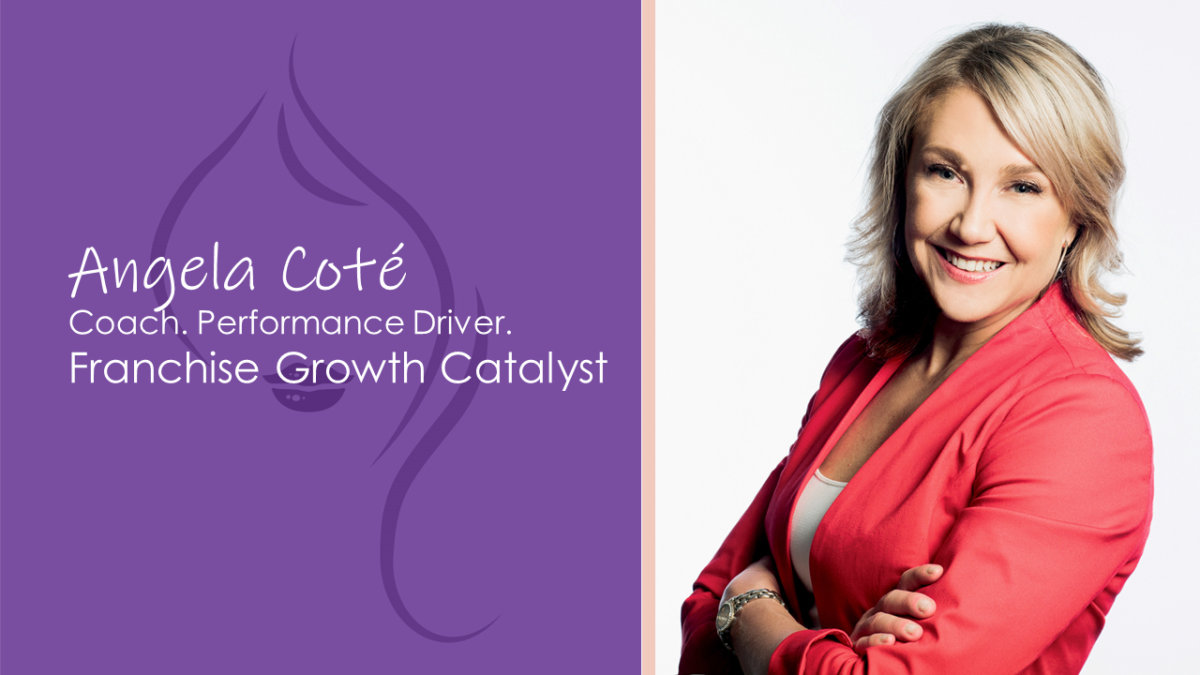
Where Passion and Purpose Collide – Angela CotĂ© Interview

On the first episode of Where Passion and Purpose Collide, Angela CotĂ© talks leadership as the boss’s daughter, denim, roundtables and how to Play Bigger! Don’t miss her interview with Rebecca and Elizabeth, and be sure to check out her new Play Bigger Performance Groups!

Follow us on YouTube.

Follow us on Spotify.

Join The Coterie for Women today!

How to Deliver Bad News In a Good Way

By Nancy Friedman

A long time ago, we at Telephone Doctor Customer Service Training, decided to remove whatever negativity in our life we could. We removed as many negative words, negative thoughts, and, yes, even negative people as we could. This has proven to be fortuitous during the current pandemic crisis. Many of you are probably giving some not-so-greatnews to your customers and maybe even to your employees.

Even during normal times, every once in awhile, owners, managers or staff will need to share negative (bad) news with their customers. We asked ourselves how we could do that effectively without saying, “I have some bad news.” receiving bad news. So what we did was remove the words “bad news.” We just don’t say it. The customer NEVER hears it. When the ‘you know what’ hits the fan and you need to call a customer to explain something that’s not just right, try our Telephone Doctor “mission possible” technique. It works faceto-face, as well.

It simply goes like this. “Mrs. Jones, I have some good news, and I have some not good news; which would you prefer to hear first?” You let the customer decide what they want to hear first. Good news or not so good news first.

Here’s an example: Let’s use the premise that their order did not come in time to make the original appointment.

You: Hi Mrs. Customer. This is Dan from XYZ. Do you have a quick moment to talk? (Without that question, your call is always an interruption.)

Mrs. Customer: Sure, Dan.

You: Good, thanks. (WITH A BIG SMILE) I have some good news, and I have some not good news; which would you like to hear first?

Mrs. Customer: Well, I like good news. Let me hear the good news first.

You: Hi Mrs. Customer. This is Dan from XYZ do you have a moment to talk?

Mrs. Customer: Sure, what’s going on? I was looking to hear from you.

You: Well I have some good news and some not so good news; which would you like to hear first? (Notice we always give the client a choice of what they want to hear first.)

Mrs. Customer: Well, let’s get the bad news over with.

You: Me, too. The good news is your product has been ordered and is alive and well and on the way. All is good on that end. The not so good news is there is a 3-day delay. A bit later than we had anticipated.

If you can offer something to ‘smooth’ the feathers, this is a good time to do it; however, shared positively, it usually works well.

You: The not so good news is the product you ordered has a three-day delay making my promise to you not so good news. The good news is you are first on the list to get it installed on the same day it comes in. Certainly, we apologize, and I know you understand the delay is not on our end, but we do take responsibility for it.

Now let’s try it when the customer wants the not so good news first.

“I’m not sure about you, but I’ve never met anybody who enjoys receiving bad news. Every industry has situations that call for delivering bad news. (Or rather ‘not so good news.’) And this technique will fit every industry. I’ve used it for years. And a bonus? It’s GREAT in your personal life as well! It has always lightened the load and made things much easier.

KEY: Delivery, tone of voice, confidence and smiling are all critical in delivering this statement. There can be no “ummmms” or “ahhh” or over-apologizing.

What bothers people the most is when you don’t offer them an alternative, or you just give them “bad news” without helping.

REMEMBER: No one wants to hear “bad news.” And most people can adapt to “not so good news.”

The other day my husband came to me and said, “Hey Nancy, I’ve got some good news and some not so good news; which would you like to hear first?”

I fell for it and said, “Well, give me the good news first.”

He said, “Well, the good news is our new puppy is doing very well on potty training; the not so good news is – his mistakes are on your side of the bed.”

Laughter lightens the load. Especially now.

Nancy Friedman, Founder and Chairman of Telephone Doctor Customer Service Training, is a sought-after speaker for franchise and corporate conferences, sharing tips and advice in customer service, communication and sales.  As a former franchisor, she brings the good, bad and ugly for us to review.  Author of nine books,  Nancy can be reached at www.nancyfriedman.com, or email her at nancy@telephonedoctor.com or call: 314-291-1012 CST.

Roses and Thorns – Snakes and Kumbya

On this episode of Roses and Thorns, Kumbaya Rebecca learned that standing up for yourself (rose) when someone treats your poorly (thorn) can be empowering. And Elizabeth’s encounter with a snake (thorn) taught her that she can still jump (rose) after knee and ankle surgery! What are your Roses and Thorns for the week?

Follow us on YouTube.

Follow us on Spotify.

Join The Coterie for Women today!

Angela Coté on Where Passion and Purpose Collide

On our very first episode, Rebecca Monet and Elizabeth Denham interview Angela Cote about everything in her world of franchising – from denim and costumes to fun and accountability. And do you know how to Play Bigger? Angela lets us in on a new project!

Watch show on The Coterie for Women YouTube

Listen to show on Spotify

Continue reading “Angela CotĂ© on Where Passion and Purpose Collide”

Navigating Disaster Relief Programs During COVID-19

Do You Qualify?

by Elizabeth Denham

Bethany Barnes, Director of Business Development at Rapid Business Plans, is using her experience to help businesses navigate the process of applying for stimulus monies to keep them afloat through the pandemic crisis.

“I write business plans every day for people who are applying for SBA loans for their businesses,” Barnes said. “I know what banks are looking for and how to help them through the process.”

When Barnes realized the impact the coronavirus was going to have on the economy, she knew her skillset could help people try to weather the storm and stay in business.

“We are doing whatever we can to help,” she said. “We are sending out information, resources and links as we get them. Some people are great at doing it all themselves, and we guide them to resources. Others hire us to complete the process from start to finish and send their documentation to our Dropbox so that we can do all of the heavy lifting.”

The process Barnes takes people through is fairly simple. There is a questionnaire on her website to help you determine if you qualify. Credit is a factor in qualifying. If your credit score is below 640, she will recommend that you do not apply, and she will suggest other options. Once it is determined that you may qualify, Barnes will help you research what you qualify for in your state and through federal programs.

“We have been recommending businesses apply for as much as eight months of expenses,” Barnes said. “We think that is a reasonable timeframe to expect to be impacted by the crisis.”

“We have been recommending businesses apply for as much as eight months of expenses. Disqualifying Factors ‱ Credit below 640 ‱ An arrest within the last six months ‱ Previous defaults on government loans Programs State Bridge the Gap Loans Programs vary from state to state, but in Florida, for example, you can apply for up to $50,000, 12 months, interest-free. This money would be paid back from proceeds from business interruption insurance or federal disaster assistance. Barnes can let you know what your state is offering. Federal SBA Disaster Loans – EIDL and PPP7(a) Loans Economic Injury Disaster Loan- The federal government has set aside $50 billion (possibly more in the future) in SBA disaster loans that you can obtain for your business or for personal disaster assistance. Low-interest loans up to $2 million are available at a proposed 3.75% rate amortized over up to 30 years. A credit score of under 640 will be immediately rejected and we cannot recommend applying. PPP- Provides up to two months of payroll, rent and utility expense that can be forgiven. If you have received an EIDL loan for different purposes, you are also eligible for this loan. If you have access to other traditional lending, you may not qualify for this program. Traditional SBA 7(a) Loans The CARES Act passed by Congress on Friday, March 27 has a provision providing six months of payments for all SBA 7(a) loans—existing and new—which are not deferments, but rather full payments of principal and interest to the lender for which the borrower will never be responsible again. For new SBA 7(a) borrowers, six months of payments of principal, interest and any associated fees beginning with the first payment due on the loan is available for new loans made within the first six months starting from the date of enactment (3/27/2020).

All in all, Barnes is helping people in whatever ways she can. She has done everything from sending out recipes to helping set up grocery delivery for people. She even helped an ICU nurse get set up with a trauma therapist.


“It’s important to look at ways we can help during this chaotic time,” she said. “I believe the franchise industry will be resilient, and these loans can help them get through the crisis. When they get through it, there will be more of the market share available to them, and they will come out stronger.”

For more information, visit www. rapidbusinessplans.com or text Rapid Business Plans office line at 904.999.3133.

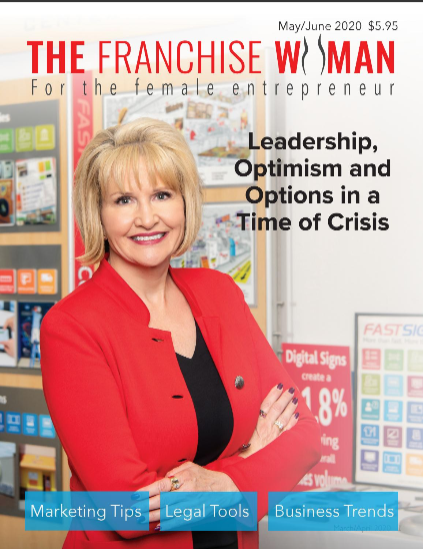
Leadership in the Time of Crisis

by Elizabeth Denham

The Crisis

“Mentorship is absolutely critical, especially in this time of coronavirus. It goes back to the idea of never stopping learning.”

IFA Chair and FASTSIGNSÂź CEO Catherine Monson has taken her leadership roles to a new level during the COVID-19 pandemic which has impacted every business across every industry. From webinars to videos and from early preparation to constant communication and support she has not, for one moment stopped trying to protect her people. She continually supports her franchisees and ensure the franchising community will weather the storm and come out strong and intact.

“We have had to address issues from both a practical standpoint and an emotional one,” Monson said. “And the principles of success that I speak about are even more critical right now, especially the one about never stopping learning. While I always knew we would face another recession, I didn’t know it would be due to a worldwide health crisis. The COVID-19 pandemic is unprecedented, so we have had to continue learning and adjusting and pushing forward.”

Monson often speaks about what she believes are the Five Common Characteristics of Highly Successful People. Those characteristics are:

1. Positive Mental Attitude 2. Goal-Directed Behavior 3. Self Motivation 4. A Sense of Urgency 5. Never Stopping Learning

Emotional Support

When the pandemic began, Monson had a conference call with 500 franchisees to discuss the issues and offer reassurance. Her usual “Connect with Catherine” conference calls with her franchisees took place every eight weeks and have now become weekly calls. She began creating weekly videos for her franchisees to build their skills in focusing on what they can control, perseverance and resilience; she shared those with the IFA, which posted them on their coronavirus site for membership. IFA members responded positively and at the request of the IFA senior team, she has made and distributed videos specifically for the IFA membership discussing courage, self-talk and keeping a positive mental attitude, to name a few. She has shared her story of overcoming struggles, and she has encouraged bravery.

Scared is what I’m feeling. Brave is what I’m doing. “

“Scared is what I’m feeling. Brave is what I’m doing,” she said in one video as she continually encourages leaders to rise to the challenge. She guides organizations to use the power of courage and positive thinking to push out fearful and negative thoughts and meet each day anew.

Practical Support


As FASTSIGNSÂź CEO, Monson has analyzed operations, supply chain and the reality of remote working and social distancing. She has provided guidance and instruction to her franchise network on how to pivot and produce COVID-oriented signage and other products19-. She has provided guidelines for using remote platforms, offered best practices for working from home and helped with navigating a recession.

“A year-and-a-half ago, I had the team begin working on a document called, ‘How to Weather the Next Recession,’” she said. “It was 95 percent done last summer. Seventy-five percent of it applies to all businesses and the other 25 percent to the signage industry. We pulled it out, polished it and renamed it, ‘How to Weather the Next Economic Storm or Time of Uncertainty.’ We sent it out several weeks ago. It includes specific and detailed action steps to build sales, reduce expenses and improve cash flow.”

FASTSIGNS¼ created a special website solely to support franchisees during this pandemic called the “Prepared” site. It includes a deep collection of information on operations, technology, supply chain, real estate support, sales support and COVID-19-specific marketing materials. Franchisees send in photos of the signs and products they are selling and share success stories, all of which are posted to the “Prepared” site, inspiring and motivating fellow franchisees. The site also includes educational information about social distancing and provides artwork for the stores to sell to customers about social distancing, new business practices, etc.

FASTSIGNS¼ has also begun offering sneeze guards and safety barriers to protect employees of essential businesses, face guards for essential workers and even intubation shields to keep medical workers safe. gressional Leadership, the White House and with Steve Mnuchin on legislation to help save small businesses; the IFA was instrumental in getting many franchise businesses protection in the CARES Act. The IFA is providing daily webinars— often two to three a day— for everyone on the IFA member list. The webinars are designed for franchisees and franchisors and provide ideas and advice on how to navigate this crisis. The IFA has brought in franchisors, suppliers and franchisees to offer advice and provide tools.

“Our goal is to provide value to every IFA member,” Monson said. “We want them to know we are here for them during this crisis and beyond. And together, we will get through it and come out even stronger.”