
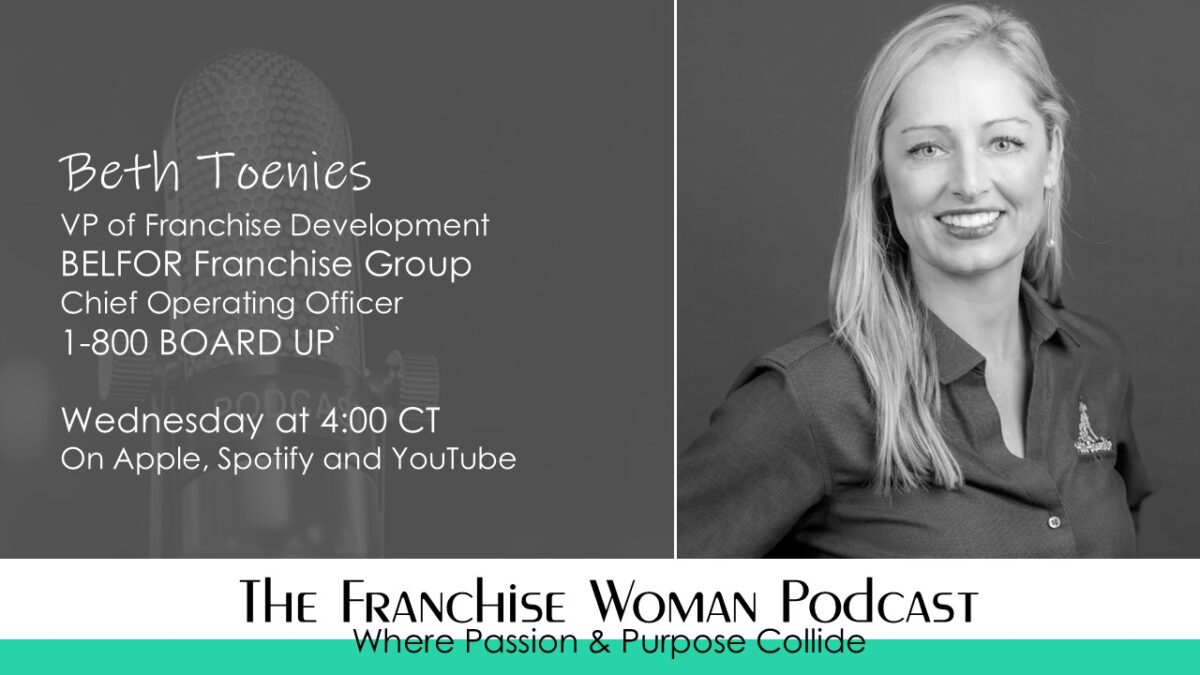
Featuring Beth Toenies on The Franchise Woman Podcast
In franchising, leadership isn’t tested when things are running smoothly. It’s tested when everything hits at once: deadlines, decisions, difficult conversations, unexpected changes, and high expectations from the people depending on you. In those moments, the leaders who stand out aren’t always the smartest or most experienced. They’re the ones who can remain calm, assess clearly, and take purposeful action even when everything feels urgent.
That is the heart of this episode of The Franchise Woman Podcast, where host Rebecca Monet and co-host Tracy Kawa welcome franchise executive and operations leader Beth Toenies for a conversation centered around mindset, resilience, and real-world leadership. Rebecca sets the tone immediately: the topic is the mindset every leader strives for—the ability to stay calm, focused, poised, and effective under pressure. The episode title says it best: “Keep Calm and Get Things Done.”
What “Keep Calm” Really Means in Leadership
Beth clarifies something important early in the conversation: staying calm doesn’t mean you never experience anxiety, pressure, or fear. It also doesn’t mean you have all the answers. Instead, calm is a leadership practice—one that requires awareness and discipline.
Beth explains that real leadership often involves multiple complex problems happening at the same time—sometimes not in threes, but in “double digits.” Her approach isn’t denial or avoidance. It’s acknowledging the reality of a situation, giving herself permission to feel it, and then shifting quickly into clarity and action.
One of her most powerful points is the idea that calm leadership is rooted in humility. Beth openly shares that she has anxiety and actively works through it. She emphasizes the importance of recognizing when anxious thoughts can cloud decision-making—and learning how to manage them instead of allowing them to take control.
This is a refreshing message in today’s culture where anxiety is sometimes worn like a badge of honor. Beth encourages the opposite of glorifying overwhelm: recognize it, address it, and develop tools to move forward with clarity.
Prioritizing Without Panic: A Simple (Old-School) Method
When everything feels urgent, prioritization becomes more than productivity—it becomes survival.
Beth shares a surprisingly simple tool she uses to calm the mental chaos: she writes things down. Not in an app. Not with AI reminders. A physical list.
She explains that writing down the top priorities helps ground her. Instead of letting technology dictate urgency, she creates order deliberately, using her own judgment and instincts. This isn’t about checking off small tasks. Beth focuses on the “rocks”—the big, foundational priorities that actually move the needle forward.
Rebecca adds an important behavioral insight: there is a strong connection between the brain and the hand. Writing something down can help the unconscious process priorities more effectively, even while you sleep. In a world dominated by digital tools, this conversation serves as a reminder that calm leadership often comes from practices that slow you down just enough to think clearly.
Calm in the Real World: Leading Through Acquisition Uncertainty
Many leaders can speak about mindset in theory. Beth demonstrates it in practice.
One of the most compelling moments in the episode is when she shares a story from her time at 1-800-BOARD-UP, where she served as Chief Operating Officer. Beth explains that after the company was acquired by BELFOR Franchise Group, the franchise network was understandably uneasy. There were concerns about competition, uncertainty about the future, and fear about what was going to change.
Beth describes the weight of leadership in that moment: franchisees were looking to her for truth and stability, and leadership was looking to her to unify and move forward.
Instead of pretending to have all the answers, Beth leaned into authentic leadership. She told the franchise community what she knew, what she didn’t know, and what she could confidently commit to—support, clarity, and care.
The results were significant. Beth shares that franchise systems can lose more than 20% of their franchise base during acquisitions and major change. In their case, they retained the majority—an outcome she attributes to calm leadership, transparency, and trust.
This is a crucial lesson for franchising: franchisees don’t need perfect answers. They need confident leadership, consistent communication, and a steady hand in uncertain times.
Empathy and Decisiveness Aren’t Opposites
Rebecca asks a question many leaders wrestle with: how do you balance empathy and decisiveness?
Beth’s answer is direct: they belong together.
In difficult situations—whether it’s a major business shift or a painful personnel decision—Beth emphasizes the importance of recognizing emotions without allowing them to blur logic. The leader must acknowledge the weight of the moment, respect what others may be feeling, and still make clear, responsible decisions.
This is where her leadership style stands out. Beth doesn’t lead through chaos, panic, or emotional swings. She leads by grounding others, keeping morale intact, and helping teams move forward with a sense of stability.
What to Do When Things Go Off the Rails
Even the best leaders make decisions that don’t work out. Beth speaks openly about that reality, and her guidance is valuable for any executive team.
Her key message: course correction requires humility.
Beth explains that leaders must be willing to admit when something needs to be re-evaluated. If new facts emerge, it’s not “second-guessing”—it’s responsible leadership. She encourages leaders not to dwell in regret, but to move quickly through disappointment and shift into solution mode.
Tracy summarizes this beautifully: it’s about owning the situation and staying connected to the team, not only handling the problem but maintaining morale through the setback.
Perspective is the Secret Weapon
Beth shares personal context that deepens the meaning of her leadership philosophy. She is raising a military family while her spouse deploys regularly, and she has two young children—one of whom has significant medical complexities requiring intensive care.
This part of the episode brings the concept of calm into a much deeper place. Beth explains that with so many responsibilities, staying calm is not optional. Without intentional calm, everything turns into a mental tornado—and it becomes difficult to respond at all.
Her story is a reminder that leadership isn’t just a business skill. It’s a life skill. Perspective changes everything. When you’ve faced real life-and-death situations, it reshapes how you view urgency at work. It helps you lead more effectively because you’re grounded in what truly matters.
Recharging: The Discipline of Making Space
Beth also addresses something leaders often neglect: recharging.
She acknowledges that you can’t stay calm and effective indefinitely without rest. Recharging doesn’t always require large blocks of free time. Even small moments—listening to an audiobook, closing your eyes on a flight, taking 10 minutes to step out of the chaos—can restore mental clarity.
Beth’s approach is practical and realistic for high-performing leaders and parents alike: make room for yourself in whatever way you can, and do it intentionally.
The Future of Entrepreneurship: Why Home Services is “AI-Proof”
Toward the end of the episode, Beth shifts from leadership mindset to opportunity—and her insight is especially relevant in today’s world.
Beth believes the future of entrepreneurship is strong for women and veterans in particular, and she points to the home services sector as one of the most promising areas. Her reasoning is simple: AI and robots may transform many industries, but they’re not going to fix toilets at 2 AM, respond after fires, or comfort families during emergencies.
She calls home services “AI-proof,” and highlights how franchising provides a proven playbook that allows business owners to grow faster without reinventing the wheel.
Final Takeaway: Calm is a Leadership Strategy
This episode is a reminder that composure isn’t just personality—it’s a practice.
Beth Toenies demonstrates that calm leadership is not about having perfect control. It’s about having the mindset, the structure, and the humility to keep moving forward with clarity.
When leaders stay calm:
- teams feel safer,
- decisions become clearer,
- priorities become manageable,
- and outcomes improve—even in chaos.
If you’re leading a franchise, building a team, or navigating growth, this conversation is one you’ll want to revisit again and again.